All Posts By Antonio RussoJune 29, 2026 · 6 min read
Crossed: A summer crossword to help learn Microsoft Cloud security.
By Antonio RussoJune 29, 2026 · 6 min read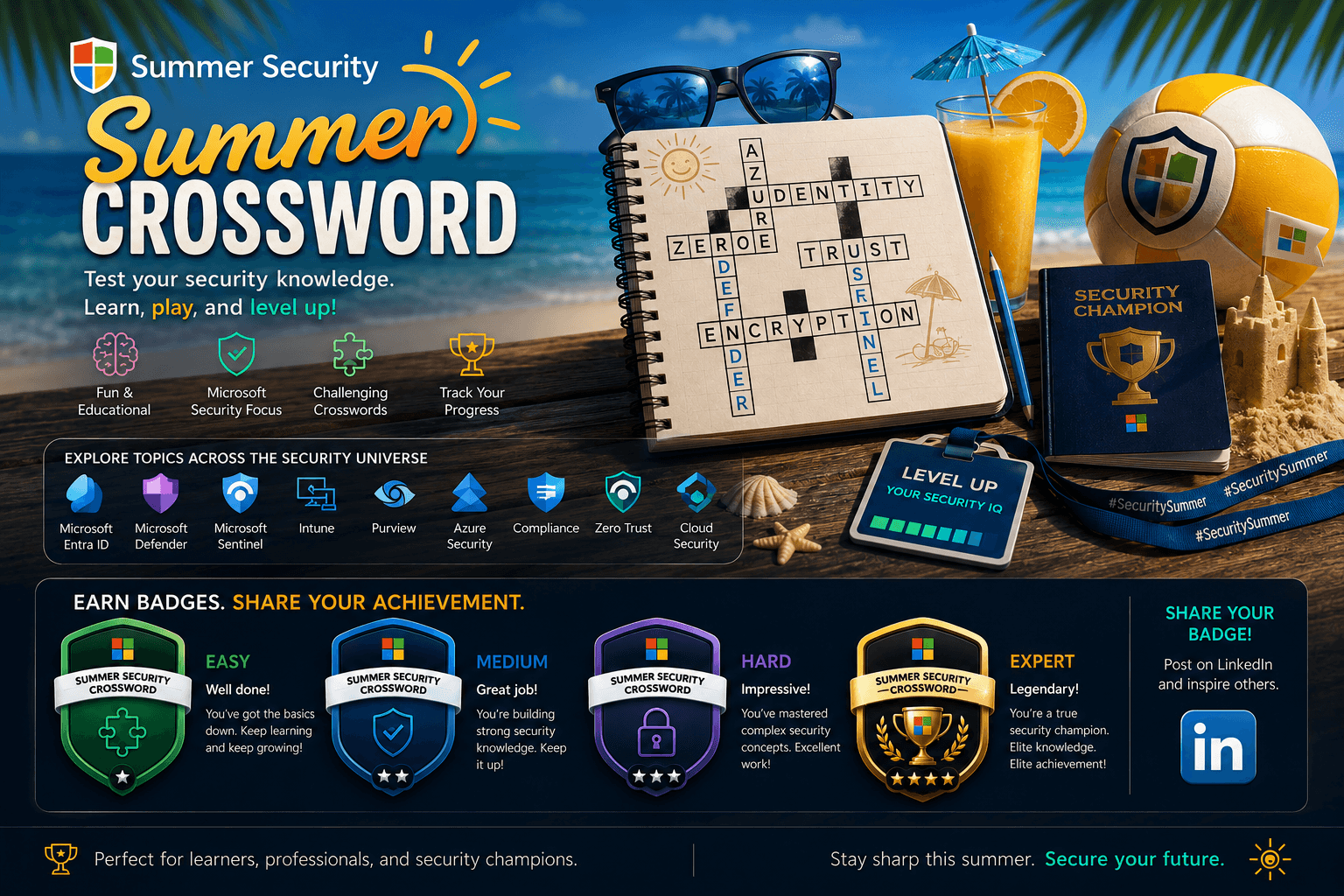
Try Crossec now . . .
Some side projects start with a problem. This one started with a feeling: it is summer, security learning is usually dry, and a crossword is a genuinely fun way to drill the vocabulary of a field. So I built crossec , a browser crossword game about Microsoft Cloud security that generates a fresh puzzle every time you play, runs on four difficulty levels, and hands you a shareable badge when you finish.
It is free, there is nothing to install, and it works on your phone, your tablet, and your laptop. This post walks through what it is, how the game works, and the architecture underneath - which happens to cost nothing per month to run
The idea: learn the words, then learn the field
If you work with Microsoft Entra, Defender, Intune, Sentinel, or Defender for Cloud Apps, you already know the feeling of a field that runs on acronyms and product names that change every couple of years. ASR. PIM. Conditional Access. The service that used to be Azure AD and is now Entra ID. The thing that used to be MCAS.
A crossword is a surprisingly good teacher for exactly this kind of knowledge, because it rewards two things at once: recognizing a concept from a description, and recalling its exact name letter by letter. crossec leans into that. Every clue is about a real Microsoft Cloud security concept, written to be accurate, and the puzzle mixes current technology with a bit of memorabilia for the people who remember the old names.
How the game works
A new puzzle every time. crossec does not ship a fixed set of puzzles. Each time you start a round, the game assembles a fresh crossword in your browser from a bank of verified security concepts, laying the words out so they interlock. Because the layout is driven by a seed, the same seed always produces the same grid - which is handy for testing - but in normal play you get a different board each time.
The same topics at every level - only the clues get harder. This is the part I care about most. crossec does not lock easier topics away from beginners or hide the fun stuff from experts. Every difficulty draws on the full range of topics. What changes is how the clue is phrased for the same answer:
- Easy is plain recognition. "Microsoft's endpoint protection brand."
- Medium is applied. You need to know what a thing does, not just its name.
- Hard is precise and acronym-driven. Less hand-holding.
- Pro is cryptic and scenario-based - the kind of clue where you have to reason from a real situation to the exact term.
 This game is not affiliated with or endorsed by Microsoft. The logo is used as a courtesy, and the achievements are intended solely for fun and educational purposes!
So a beginner and a veteran can both play the same subject matter, each at a level that stretches them. Easy puzzles are smaller and gentler; Pro puzzles are large, dense, and unforgiving.
Badges you can actually keep. Finish a difficulty and crossec draws you a badge - one of four, escalating from a modest finish all the way up to a premium top-tier reward. The badge is generated right there in your browser and you can share it or download it. Your browser quietly remembers which ones you have earned, so it can give you a friendly nod if you complete one again. That memory lives only on your device.
A background that plays along. Behind the game, a field of cubes drifts and rotates like scattered crossword blocks, and every so often they choreograph themselves into a shape - an abstract four-colour square, a sun, a slice of watermelon - before dispersing again. It is summer, after all. The whole thing is built to stay smooth and battery-friendly on a phone, and it gets out of the way while you are actually solving, so the grid stays crisp and readable.
The architecture: how it costs nothing to run
Here is the part that other builders tend to ask about. crossec is engineered to run at zero monthly cost, and the trick is that there is effectively no "backend" doing work while you play.

The whole application is a static site. When you open the game, Cloudflare's edge serves a set of prebuilt files - HTML, JavaScript, CSS - from its global cache. Everything after that happens in your browser:
- The puzzle generator runs client-side. There is no server computing a crossword for you. Your browser takes the verified concept bank and builds the grid locally. That is what makes "a new puzzle every time" free - nobody is paying for compute per play.
- The clue bank is a static file, not a database. All the security content lives in a JSON file that ships with the app. There is no database query when you play, which means no database to host, scale, or pay for. It also means the content is reviewed and fixed in advance rather than generated on the fly - more on why that matters below.
- Badges are drawn in the browser. Each badge is rendered with the canvas API on your device and exported as an image. No image server, no rendering service.
- Your progress stays on your device. Which badges you have earned is kept in your browser's local storage. No accounts, no identifiers, no IP logging, no tracking. The game does not know who you are, and that is by design.
- The only server-side component in the whole system is an optional Cloudflare Worker reserved for generating rich link-preview images when you share - and even that is a future enhancement; the game ships fine without it.
Deployment is just as boring, in the best way: the code lives in a public GitHub repository, and every push to the main branch runs the test suite, builds the static bundle, and deploys it to Cloudflare Pages. The whole pipeline takes about thirty seconds.
This is the same set of principles behind the other tools I build under the aboutcloud.io banner: Cloudflare-native, free-tier hosting, no backend database for user data, static and deterministic wherever possible.
Try it, and tell me what breaks
crossec is live at crossec.aboutcloud.io. Start on Easy to warm up, then see how far you get on Pro - that one is genuinely hard, even if Microsoft security is your day job. The code is open on GitHub if you want to look under the hood or suggest a concept the clue bank is missing.
It is a small thing, but that is rather the point: a summer game that happens to make you a little sharper on the platform many of us work with every day. Have fun, and go earn that top badge.
Reach out in the comments or on LinkedIn.
Note: This game is not associated and not endorsed by Microsoft. Logo usage is out of courtesy
GitHub: https://github.com/arusso-aboutcloud/crossed
— Antonio | AboutCloud
arusso@aboutcloud.io
Tags
You might also like
Aug 25, 2026
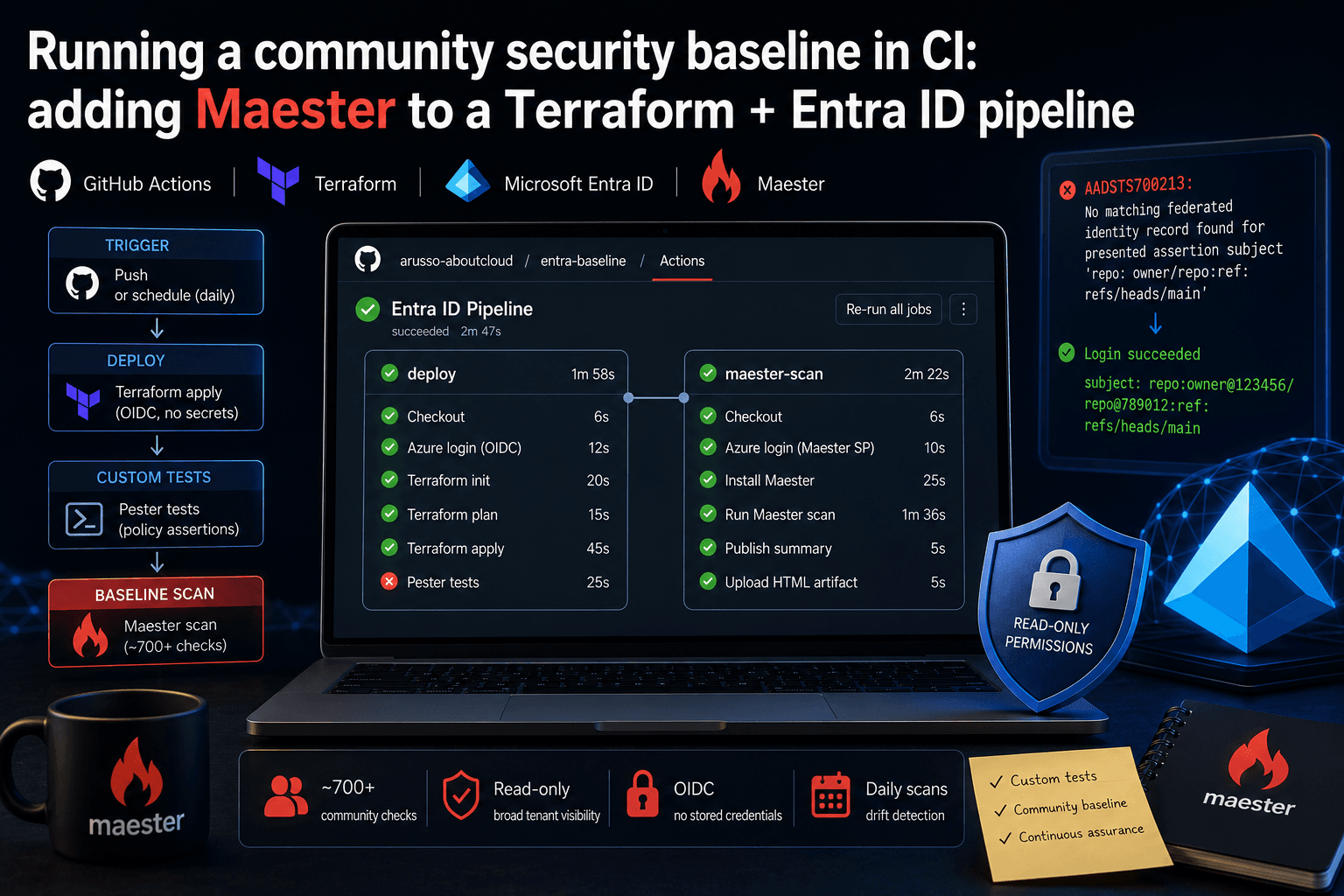
Running a community security baseline in CI: adding Maester to a Terraform and Entra ID GitHub Actions pipeline
Keeping Microsoft Entra ID secure requires constant vigilance. As security configurations, Conditional Access policies, and Privileged Identity Management (PIM) rules evolve, configuration drift becomes an inevitable risk. Manual quarterly reviews leave too much room for silent m
By Antonio Russo

Aug 12, 2026
Entra Tenant Governance hits GA: what it actually solves and where it sits in your 2026 stack
A practical read for engineering and governance teams , the actual API surface, the limits that shape your design, and an honest comparison against Microsoft365DSC | Tenant Configuration Management APIs, Maester, ScubaGear and Azure Policy. If you run identity for an organization of any size, you have two lists. The list of tenants you manage, and the list of tenants that exist. They are not the same list, and the gap between them is where incidents start. On 10 August, Microsoft moved Entra T
By Antonio Russo